Why My Smartwatch Made Me Quit Alcohol
What seeing my sleep, heart rate, and recovery changed about my choices
For a while now, I have known something was off.
Alcohol stopped landing in my body the way it used to. What once felt like ease started to feel costly. What once felt like a small pleasure began asking for a bigger price than I was willing to pay.
That realization did not come from a dramatic night or a moment of embarrassment. It came quietly, over time, as my body started sending signals I could no longer ignore.
We live in a culture that frames alcohol as sophistication. Wine is presented as refinement. Cocktails are packaged as relaxation and reward. Drinking is woven into our ideas of celebration, adulthood, and even self care. It is easy to believe that removing alcohol means removing pleasure itself.
At the same time, another narrative has been growing louder.
Alcohol is a carcinogen.
As cancer rates continue to rise sharply among Generation X and millennials, especially cancers of the colon, stomach, breast, and ovaries, it becomes harder to wave that fact away. This is my cohort. These are my peers. People my age are getting sick at rates we were not supposed to see yet.
There are many contributing factors. Environmental toxins. Microplastics. Diet. Chronic stress. Hormonal disruption.
But alcohol stands apart because it is one of the few variables we actually have agency over.
That awareness has been sitting in the back of my mind for a long time. Every glass came with a quiet question attached to it.

How This Became a Pattern
I enjoy wine. Love delicious food. And I absolutely enjoy ritual. Cooking a beautiful meal at home has become one of life’s simple pleasures, especially as restaurants have become increasingly expensive and less accessible.
The pattern that developed was subtle.
I have always been a sipper. A small pour. A slow drink. When the glass emptied, I topped it off. Because the intake felt gentle, the effect felt minimal. The evening stretched. Music played. Dinner unfolded.
Somewhere along the way, half a bottle would disappear.
At the time, it did not register as excess. It registered as atmosphere.
This rhythm intensified during the pandemic. Long evenings. Fewer external anchors. More time alone with habits that felt harmless and even comforting.
Over time, my body began to push back.
Mornings arrived with a fog that settled behind my eyes. A dull pressure gathered at the base of my skull. My sleep technically counted, but my recovery never finished. I woke up feeling muted instead of restored.
I tried to explain it away. Hormones. Stress. Late nights.
Earlier this year, I decided I did not want alcohol in my house anymore. That boundary held briefly. Then it collapsed. Old patterns carry weight.
What finally shifted everything was not guilt or willpower.
It was math and data.
The Wine Math That Changed My Perspective
In my mind, a bottle of wine equaled four glasses. That framing felt reasonable. Conservative, even.
The reality is different.
A standard bottle of wine contains five standard glasses, with a standard glass measuring five ounces. Most people do not pour five ounces at home. A casual pour is closer to six or seven ounces. When you top off repeatedly, it becomes almost impossible to track how much you have actually consumed.
Half a bottle of wine is not insignificant. It is two and a half standard drinks.
When that happens quietly, a few nights a week, without feeling intoxicated, it does not look like overconsumption. It looks like normal life.
That realization alone explained why my body was responding the way it was.

The Night That Made It Undeniable
A few nights ago, I attended a movie premiere. Beautiful venue. Great energy. They served a cocktail. One of those fruity drinks where the sugar masks the alcohol so completely that it barely registers.
I had one.
Later in the evening, I had a limoncello. Anyone who has had one knows how deceptive it can be. I slowed down. I sipped water. But by the time I left, I could feel it settling in.

I went to bed late. I fell asleep quickly.
What looked like sleep on the surface was anything but restorative.
That night, my smartwatch recorded a sharp drop in REM sleep and deep sleep. My heart rate stayed elevated throughout the night instead of dipping. My recovery metrics cratered.
Over the next two nights, my sleep continued to fragment. Even when I logged enough hours, the quality never rebounded.
I woke up with that familiar pressure behind my eyes. Not a hangover. Something duller. Heavier.
And this time, I could see it.
What Alcohol Was Doing That I Could No Longer Unsee
Alcohol sedates the nervous system, but sedation is not the same as sleep.
It helps you fall asleep faster by increasing inhibitory neurotransmitters. As it is metabolized, the nervous system rebounds. Stress hormones rise. Sleep cycles fragment.
REM sleep gets suppressed. Deep sleep shortens. Heart rate stays elevated. Core temperature increases. The liver works through the night detoxifying instead of allowing full repair.
You wake up having technically slept, but biologically unfinished.
Seeing this in real time changed everything for me.
The romance evaporated.
Once you see what alcohol does to your sleep, your heart rate, and your recovery, it becomes very hard to justify the tradeoff.
Getting Down to Brass Tacks – What These Numbers Are Actually Telling Me
Before I jump into why I am choosing sobriety, I want to slow this down for a second and make sure we are reading these numbers correctly.
It would be easy to glance at this data and shrug it off. I slept. I got through the day. The score was not catastrophic. That is usually where the conversation ends, and that is exactly where we miss the point.
What matters here is not simply whether I slept, but how my body moved through the night.

The Daily Comparison
On the nights where I had alcohol, the same patterns showed up again and again. Total sleep time dropped sharply, sometimes down to three or four hours.
REM sleep and deep sleep were reduced or flagged below optimal ranges. At the same time, my resting heart rate stayed elevated, sitting in the low 70s and even climbing into the 80s. That tells me my nervous system was under strain while I was supposed to be recovering.
My Sleep Patterns & Recovery Efforts Were Severely Impacted
Alcohol did not carry me into deep, restorative sleep. It disrupted the structure of it.
REM sleep is where memory consolidation, emotional regulation, and mental recovery take place.

Recommended Daily REM Sleep Benchmark
20–25% | ~90–120 minutes Per Night
Deep sleep is where physical repair, immune function, and hormonal regulation are supported.
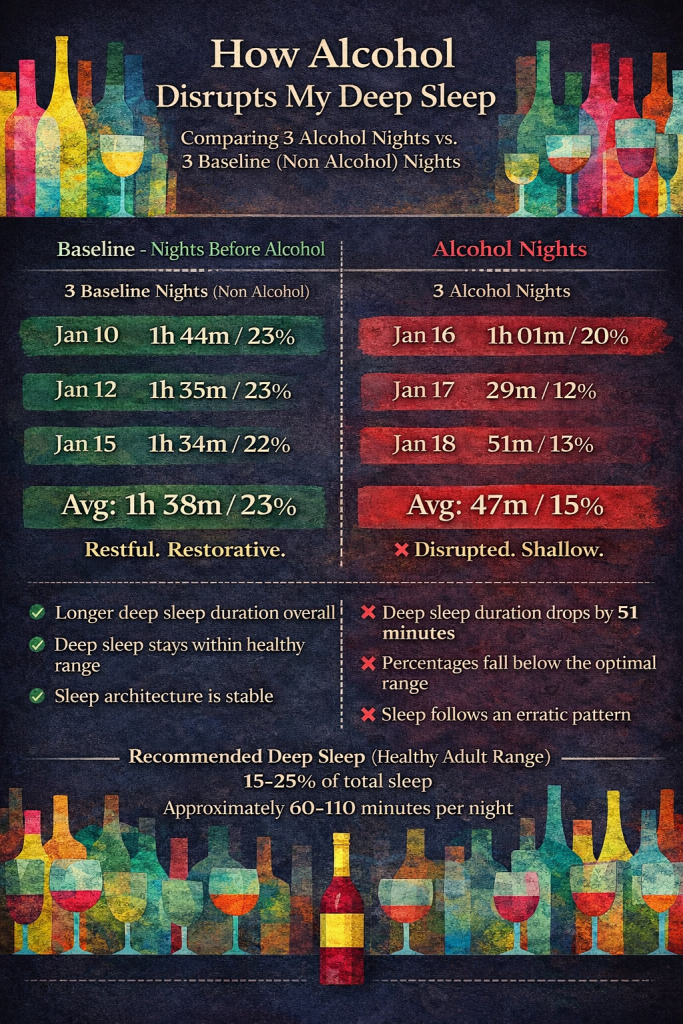
When both are compromised, the body is not rebuilding. It is simply getting through the night.
Now compare that with nights where alcohol was not part of the equation.
Sleep duration extended to six, seven, and even eight plus hours. REM and deep sleep normalized. Resting heart rate dropped into the 60s. Stress markers settled. Sleep quality moved from “OK” or “Good” into “Excellent” and “Perfect.”
Same person and watch.
The same routines.
But the one variable that changed was – alcohol.
Seeing this laid out so clearly was a wake up call. The science was simple. The data was accessible. The patterns were consistent. I did not need a lab, a study, or a warning label to tell me what was happening. My body gave me the information directly. All I had to do was stop explaining it away and actually listen.
Why I Am Choosing Sobriety
This is not about moderation for me anymore.
I am choosing to stop drinking.
Not because alcohol is evil or because I cannot handle it. But because it no longer aligns with the life I am trying to live or the body I am responsible for stewarding.
We have been conditioned to believe that pleasure requires excess and that discipline means deprivation. We apply that logic to alcohol, to food, to sex, to every appetite we refuse to examine.
The truth is the opposite.
There is clarity that comes from order. Freedom in self mastery. Peace in realizing that you are not ruled by every impulse presented as enjoyment.
Discipline does not shrink life. It clarifies it.
For me, removing alcohol is part of a larger decision to live more deliberately. To choose recovery over indulgence, clarity over fog, and long term health over short term comfort.
My smartwatch did not shame me.
It simply told the truth.
And once I saw it, I could not unsee it.
From Data to Discernment: Bringing the Sacred Back Into the Body
All of this data forced me to confront something deeper than sleep metrics or recovery scores. It made me look honestly at how I relate to alcohol in my life and what place it actually deserves.
As a Catholic, wine is not neutral to me. It is sacred. It belongs to the altar, offered and transformed.
That reality has challenged me to distinguish between what is consecrated and what has become casual, between reverence and recreation.
Choosing sobriety or stepping away from alcohol is not about fear, restriction, or moral panic. It is about discipline, temperance, and the right ordering of desire. It’s about honoring the body as something entrusted to us, not something to numb or dull at the end of the day.
This is where fitness stops being purely physical and becomes spiritual formation.
If you want to continue this conversation through a Christian and Catholic lens and explore how alcohol, virtue, discipline, and the body intersect in the spiritual life, I expand on this reflection in a follow on article over at Theology of Fitness, where we go deeper into the sacred dimension of training, restraint, and stewardship of the body.