Strong, sculpted and feminine after 40 | RoxStar Fitness
Let’s retire the idea that an hourglass figure is something you have to starve yourself into. You can build curves with muscle, create balance with thoughtful training, and pursue strength without apologizing for it.
A few years ago, I wrote about building a ‘Coke Bottle Body,’ and apparently that article hit a nerve. Women wanted to know how to create a beautiful, strong silhouette, not simply chase a lower number on the scale. And you know what? I still love that conversation.
But now I want to take it deeper, especially for women over 40. Because when people talk about an hourglass physique, they often reduce the entire strategy to two words: smaller waist. Girl, NO. Let’s give your shoulders, back, glutes, and legs the attention they deserve.
First, what can strength training change?
We need to separate what you can influence from what your genetics already established. Training can build muscle in your delts, upper back, glutes, and legs. Nutrition and long-term habits can influence body composition. But you cannot change your pelvic bone structure, widen your clavicles, or choose precisely where body fat comes off.
So the goal is not to force your body into somebody else’s proportions. The goal is to develop the structure you have, with training choices that make sense for your own physique, movement abilities, and definition of looking good.
The hourglass training blueprint: four areas to build
1. Shoulders: the upper frame
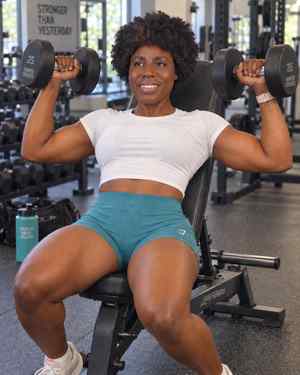
Rounded delts help create visual balance between your upper body and hips. Lateral raises, well-tolerated overhead press variations, rear-delt work, and controlled pulling can be useful. Don’t obsess over the heaviest dumbbell in the room. Own the repetition, move with intention, and progress when your technique supports it.
2. Back: shape, posture, and strength
Rows and pulldowns develop your back and help you stand taller. A stronger back is more than an aesthetic feature; it supports the pulling and carrying you do in everyday life. Work toward control through a comfortable range of motion and remember that your shoulders don’t need to live up by your ears.
3. Glutes: powerful curves, not endless kickbacks
Hip thrusts, Romanian deadlifts, bridges, lunges, step-ups, and squats can all belong in a glute-training program. But I don’t want you doing a dozen nearly identical exercises in one session. Choose a useful mix of hip-extension patterns and single-leg work that you can actually challenge over time.
4. Quads and hamstrings: the complete lower body
An hourglass look is not exclusively about your glutes. Strong, developed thighs create proportion and help your lower body function well. Squats, leg presses, leg extensions, and hamstring exercises can each play a role. Read my original quad anatomy tutorial if you want to understand the muscles you’re training,
Why the waist conversation gets so messy
You cannot selectively burn belly fat by doing crunches, twists, or an endless variety of ab circuits. Training your core absolutely matters for strength, control, and function. It doesn’t give you the power to choose where fat comes off.
If reducing body fat is an appropriate goal for you, work with your overall nutrition, resistance training, activity, and recovery. And if you’re already lean but want more curves, pursuing additional weight loss may be taking you in the opposite direction.
Your waist doesn’t need to be punished into submission. Your entire program needs to make sense. That’s the difference.
But Roxie, I’m over 40. Isn’t muscle growth harder now?
Life after 40 may bring changes in hormones, sleep, energy, stress, and training recovery. Yes, those things can affect your experience. But they don’t mean your strongest years are behind you.
A 2024 analysis of resistance-training studies in postmenopausal and older women reported gains in lean mass with training. A separate 2024 review found important benefits for strength and function. The takeaway isn’t that every woman needs identical programming. It’s that there are still reasons to train hard, intelligently, and consistently.
Maybe you need a longer warm-up. Maybe you need fewer exercises done really well instead of seven mediocre ones. Maybe the week is full of work and family responsibilities, and three solid training days are more realistic than five. Fine. We build around reality.
My sample four-day hourglass training split
This is an example for someone with lifting experience and no limiting injury. It’s not a custom prescription. Choose loads that allow controlled technique, leave some effort in reserve, and adjust the exercise selection to your abilities.
| Day | Emphasis | Example movements |
|---|---|---|
| Monday | Lower body: glutes + quads | Squat or leg press; split squat; hip thrust; leg extension |
| Tuesday | Upper body: shoulders + back | Row; pulldown; lateral raise; rear-delt raise; optional press |
| Thursday | Lower body: glutes + hamstrings | RDL or hinge; supported lunge; leg curl; glute bridge |
| Friday | Upper body + core | Row variation; shoulder press variation; lateral raise; carries or anti-rotation core |
For each session, two or three well-chosen sets of the main movements may be a sensible place to begin, with the number of sets and reps adjusted for training experience. Progress by improving repetition quality, range, load, or total work over several weeks. Recovery days are part of the plan, not a failure to be disciplined.
Nutrition for muscle, curves, and realistic body composition
Let’s talk about the elephant in the room: you cannot expect your body to build muscle on fumes. You need enough food, adequate protein, and a routine you can repeat. The right intake depends on whether you’re in a muscle-building phase, maintaining, or pursuing fat loss. Those are different situations.
Rather than eliminate every carbohydrate you enjoy, learn how to fuel training, support recovery, and manage total intake with consistency. Your best physique will not be built on panic every time the scale moves.
If you’re unsure how to structure your intake, use the Refine Your Macros Calculator as an educational starting point, then adapt the results to your needs.
Common mistakes that stall your progress
- Training only your glutes. The silhouette is a whole-body result, and the shoulders, back, and thighs matter too.
- Changing the plan every week. Your muscles need repeated, progressive work, not perpetual novelty.
- Doing endless cardio to ‘shrink your waist.’ Cardio has a place, but it doesn’t replace strength training and appropriate nutrition.
- Under-eating while trying to grow. You can’t support progressive training with chronically inadequate energy.
- Ignoring your recovery. If you’re constantly exhausted, sore, or in pain, reassess rather than pushing harder.
How to track progress without letting the mirror run your life
Record weights and reps. Notice whether your clothes fit differently. Take periodic photos if that’s healthy and useful for you. Pay attention to how your energy and movement are improving. Don’t reduce the entire story to the bathroom scale.
Some weeks you’ll see progress in your strength before you see any change in shape. That’s not a reason to throw away a good plan. That’s a reason to keep your eyes on the long game.
What should you do next?
If you’re comfortable following a structured program, you may not need high-touch coaching. You need a reliable plan and the tools to stay consistent. That’s exactly why I built Redefining Bodybuilding All-Access.
If your goal involves more complex physique changes, a training history that calls for closer attention, or a desire for personalized accountability, that’s when VIP coaching becomes the more appropriate fit.
Final thought: You don’t have to chase another woman’s shape. Build a body that is strong, capable, and unmistakably yours. That’s a transformation worth doing well.
More from the RoxStar Fitness journal
- The original Coke Bottle Body article
- Your quadriceps anatomy guide
- How to Build Strong, Feminine Arms
Research and further reading
Research on training volume in older women | Postmenopausal resistance-training review