By IFBB Pro Roxie Beckles | Redefining Bodybuilding
Imagine a woman walks into my coaching practice and tells me she wants to compete in bodybuilding.
Before I start writing workouts, adjusting her nutrition, or discussing a competition date, I have one very important question.
Which division?
Because if she tells me she wants to compete in Fit Model, I’m not going to train her exactly the same way I would if she were preparing for Bikini. And if she wants to compete in Wellness, we’re having a different conversation altogether.
We’re looking at the same woman, with the same starting physique, but three very different competitive objectives.
This is where I think a lot of women misunderstand bodybuilding.
They look at the various divisions and assume the primary difference is how much muscle a competitor carries, how lean she needs to become, or how much cardio she performs during contest prep.
But those differences begin much earlier.
They begin with the way we structure her resistance training, the muscles we prioritize, the amount of productive training volume we allocate, and how we manage her recovery throughout the off-season.
As an IFBB Professional bodybuilder who has spent decades coaching women, I don’t believe in handing every aspiring competitor the same generic program and simply changing the amount of cardio.
The division determines the direction. The individual determines the programming.
Let’s walk through what that actually means.
Watch: How I’d Train the Same Woman for Fit Model, Bikini, and Wellness
Watch the complete video breakdown on YouTube
In this video, I walk through three hypothetical training programs using the same athlete, explain how my PEAT Method guides the process, and show why each competitive goal requires a different coaching strategy.
Understanding the Difference Between Fit Model, Bikini, and Wellness
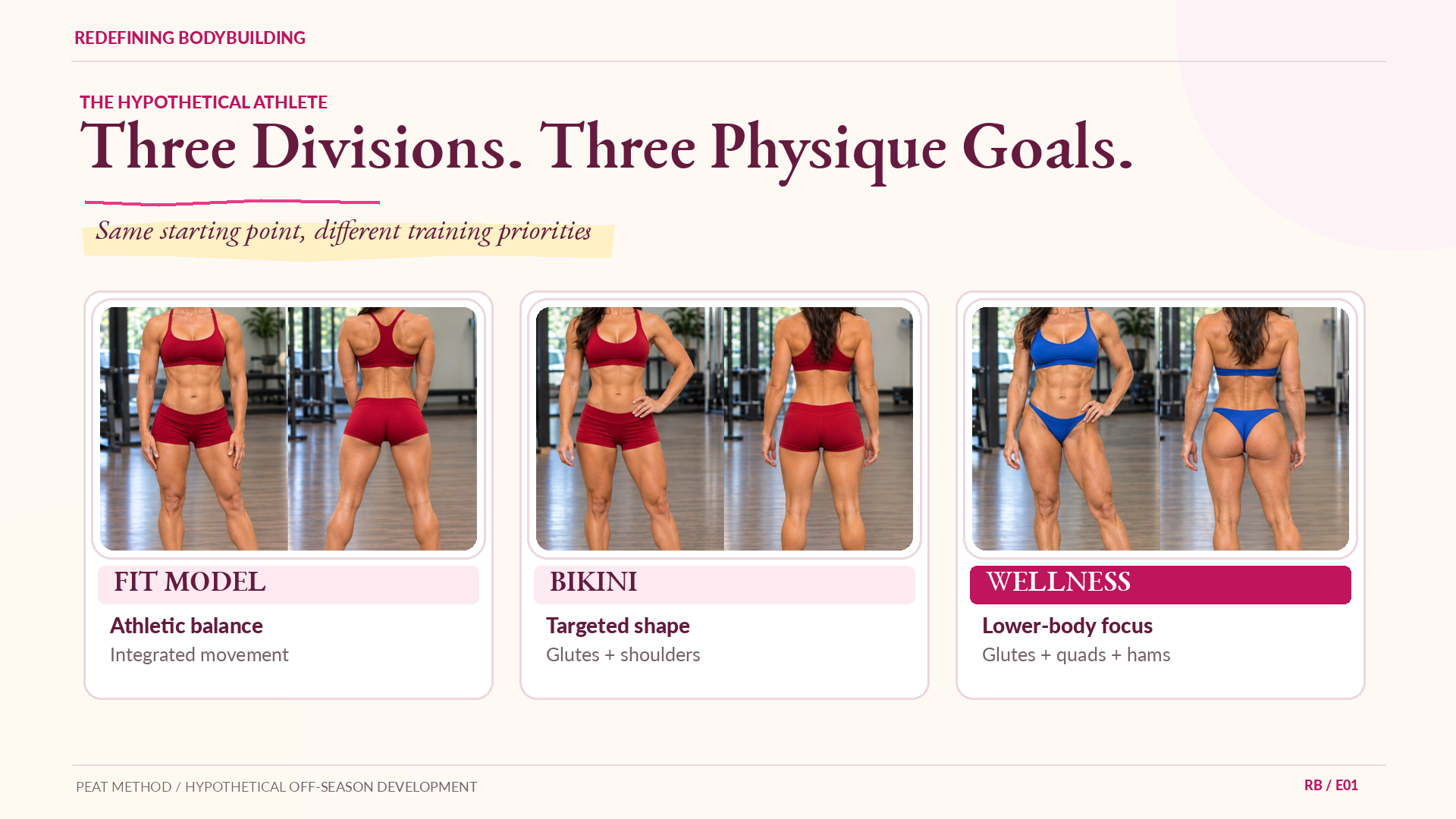
Before we choose exercises, we need to understand the physiques we’re attempting to develop.
These three divisions are not simply progressively more muscular versions of the same look. Each has its own standards for proportions, muscularity, conditioning, and presentation.
Fit Model: Athletic Shape and Moderate Muscularity
Fit Model emphasizes a foundation of muscle, balanced proportions, and an athletic appearance without the degree of muscular development expected in Bikini.
I want to see shape through the shoulders, back, arms, legs, and glutes, but I’m not necessarily trying to maximize the size of any particular muscle group.
And I certainly don’t interpret a less muscular competitive standard as permission to train casually.
For my Fit Model athlete, strength, muscular endurance, movement quality, stabilization, and conditioning remain important.
My objective is to develop a strong, balanced physique without allocating excessive training resources toward muscular specialization she may not need.
Bikini: Targeted Development and Proportion
With Bikini, we’re moving toward a more developed physique.
Now I’m examining the relationship between shoulder roundness, back development, glute fullness, hamstring development, and overall proportions.
How developed are her shoulders already? Do her glutes need additional work? Is her lower body balanced with her upper body?
These are coaching questions, not questions that can be answered by downloading a generic Bikini workout.
The goal is to develop sufficient muscle to meet the division’s intended appearance without automatically pursuing maximum muscularity everywhere.
For this athlete, targeted hypertrophy becomes a greater part of the program.
Wellness: Greater Lower-Body Development
Wellness introduces a distinctly different emphasis.
Now I’m looking particularly closely at the quadriceps, glutes, hamstrings, and the relationship between lower-body development and the upper body.
The goal is a physique with greater lower-body muscular development and appropriate balance.
But I want to address a common misunderstanding.
Just because Wellness emphasizes the lower body doesn’t mean the athlete should train her legs as hard as possible every day.
That isn’t a strategy. That’s simply adding more work.
I still need to know how much training she can recover from, which muscles genuinely require additional development, and whether the work we’re prescribing is producing the desired result.
The official NPC standards provide important context, but they don’t tell a coach exactly how many sets a particular woman needs.
For the current criteria, review the official Fit Model, Bikini, and Wellness division rules.
Why I Build the Physique Before I Think About Contest Prep
One of the biggest mistakes I see aspiring competitors make is selecting a competition date before they have developed the physique they intend to present.
They become excited about stepping onstage, find a show, and immediately begin dieting.
But contest prep isn’t the time to create years’ worth of missing muscular development.
Contest prep is primarily about presenting and preserving the muscle you’ve already built while progressively achieving the conditioning appropriate for your division.
This is why I put so much emphasis on the off-season.
It’s the period when we have an opportunity to improve strength, develop specific muscle groups, address imbalances, and establish training habits that will support the athlete when the demands of contest prep increase.
And for women over 40, I want us to be particularly thoughtful about this process.
Changes in sleep, recovery, health, stress, and lifestyle can influence the training a woman can tolerate. That doesn’t mean she should stop training hard. It means her programming should account for the body and circumstances she actually has today.
Introducing My PEAT Method
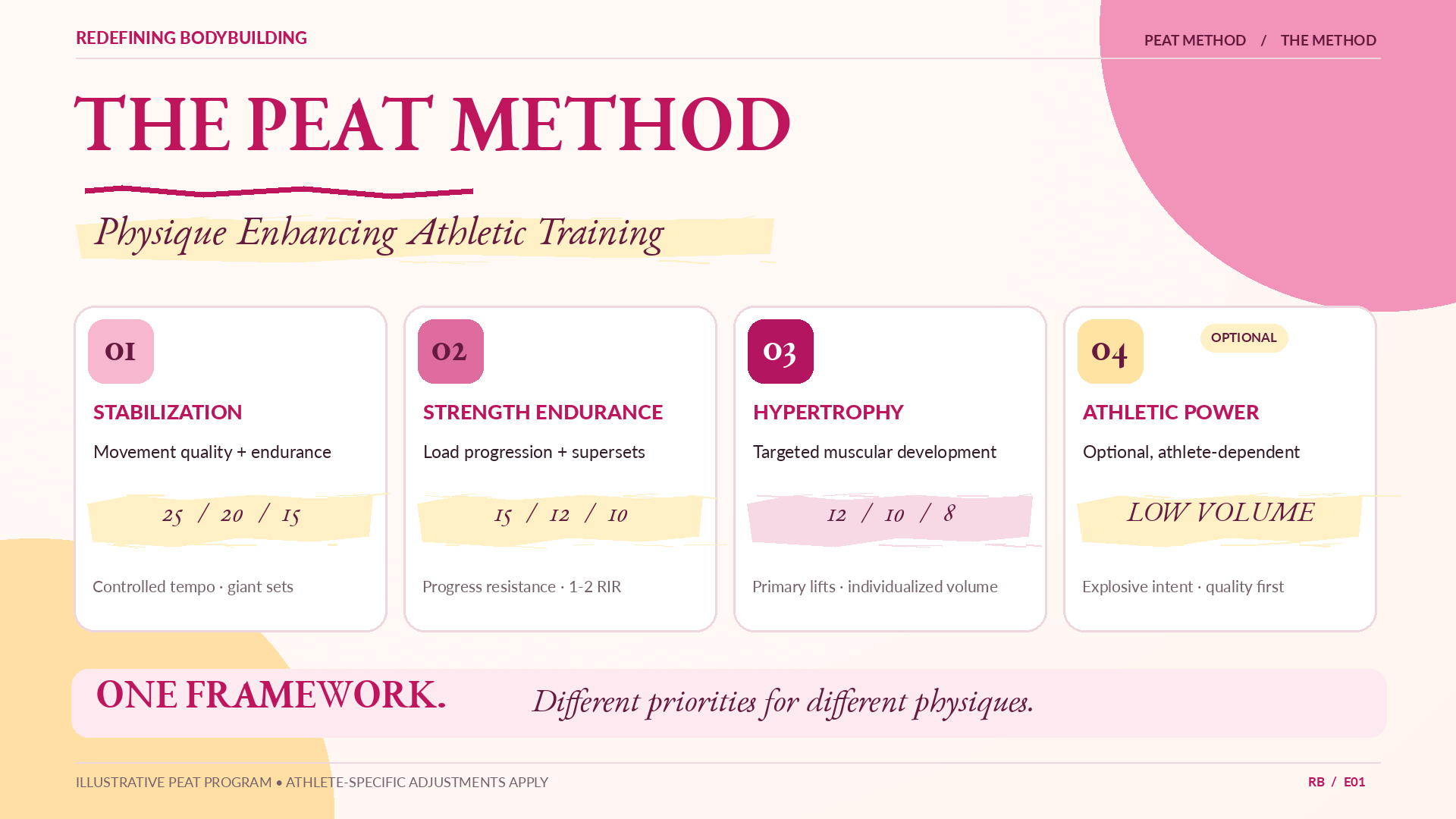
PEAT stands for Physique Enhancing Athletic Training.
It’s the training framework I use to think about building physiques while preserving the qualities that make an athlete strong, capable, and functional.
I’ve always believed that a body should do more than look impressive while standing still.
I want women to move well, develop strength, produce force, maintain control, and build the physical capacity to support their goals.
PEAT organizes those priorities through four training phases.
Phase 1: Stabilization and Muscular Endurance
This phase emphasizes movement quality, control, tempo, stabilization, and muscular endurance.
I may incorporate controlled eccentric movements, circuits, and giant sets.
One example of an ascending repetition pyramid I use on selected exercises is:
25 repetitions, then 20, then 15.
The resistance increases as the repetitions decrease, assuming the athlete can maintain appropriate technique.
This phase isn’t simply about performing light exercises. It’s about establishing movement quality and training capacity.
Phase 2: Strength Endurance
During Phase 2, I begin placing greater emphasis on strength endurance.
A typical progression on selected exercises might be:
15 repetitions, then 12, then 10.
Again, the resistance increases across the sets.
I may also incorporate supersets that pair strength exercises with complementary movements.
This allows us to challenge muscular performance while continuing to develop control and coordination.
Phase 3: Hypertrophy
During Phase 3, muscular development becomes a more deliberate priority.
For selected primary exercises, I might prescribe:
12 repetitions, then 10, then 8.
Not every exercise requires that repetition scheme. Isolation exercises, core movements, and certain accessory exercises may benefit from other ranges.
The goal is to apply sufficient resistance-training stimulus to develop the target muscles while managing recovery.
Phase 4: Athletic Power
The fourth PEAT component involves athletic power.
Depending on the woman’s background, ability, and physical readiness, I might incorporate movements such as low box jumps, jump squats, or skater bounds.
This isn’t mandatory for every athlete, nor is it necessary to include it in every eight-week training cycle.
Power training must be appropriate for the individual, particularly if joint issues, injuries, or other limitations make certain exercises unsuitable.
The Role of Progressive Loading
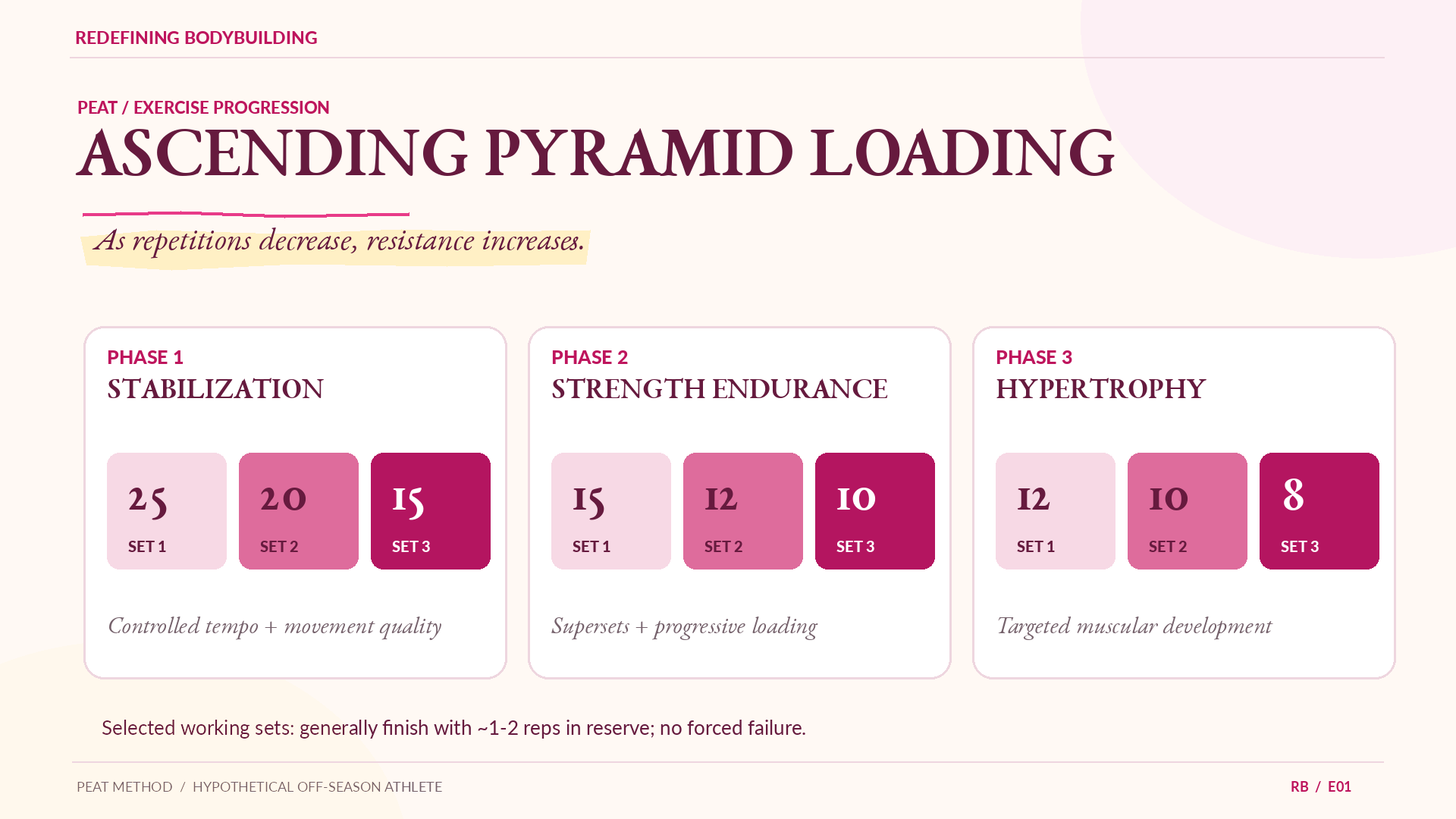
Across these phases, I often use ascending pyramid loading.
As the repetitions decrease, the weight generally increases.
For appropriately challenging working sets, I commonly aim for approximately one to two repetitions in reserve.
That means the athlete is working hard without having to take every set to complete muscular failure.
The repetition schemes are programming tools, not universal laws. What matters is how we apply them to the individual.
How I’d Structure the Training Week for Each Division
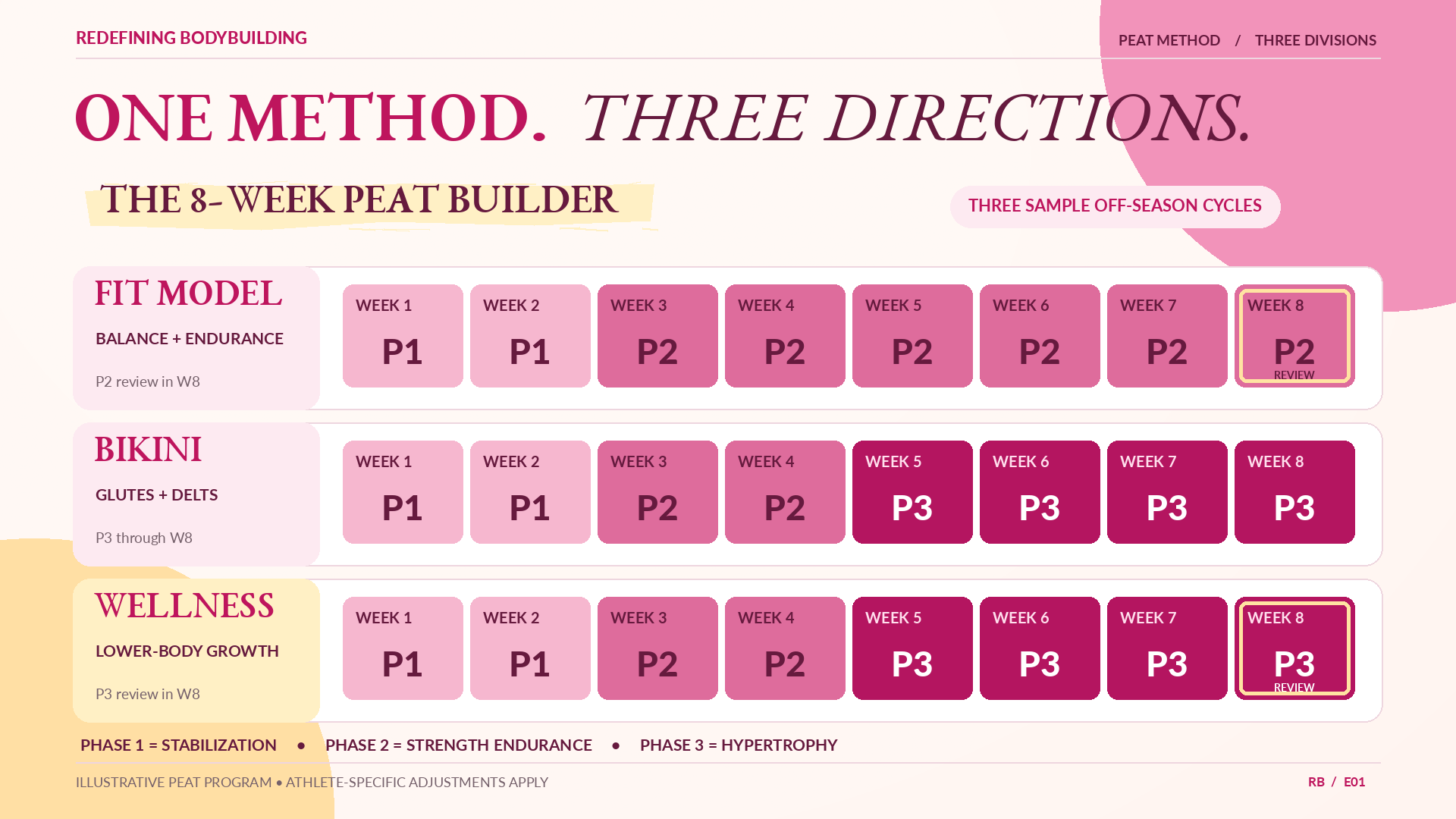
Now let’s return to our hypothetical athlete.
She’s the same woman in all three examples, but her training week changes according to her competitive objective.
Here is how I might organize the programs:
| Day | Fit Model | Bikini | Wellness |
|---|---|---|---|
| Monday | Total Body A | Glutes and Hamstrings | Glutes and Quads |
| Tuesday | Upper Body | Shoulders, Back, Core | Shoulders, Back, Biceps |
| Wednesday | Recovery | Recovery | Recovery |
| Thursday | Lower Body | Glutes and Quads | Glutes and Hamstrings |
| Friday | Total Body B | Metabolic Circuit | Total-Body Conditioning |
| Saturday | Metabolic Giant Set | Conditional Specialization or Conditioning | Conditional Lower-Body Specialization or Recovery |
| Sunday | Rest | Rest | Rest |
Notice that I’m not simply giving each athlete five hard hypertrophy workouts.
The overall amount and distribution of training have different purposes.
And Saturday, particularly for Bikini and Wellness, is conditional, not automatically another demanding training session.
Fit Model: Building an Athletic, Balanced Physique
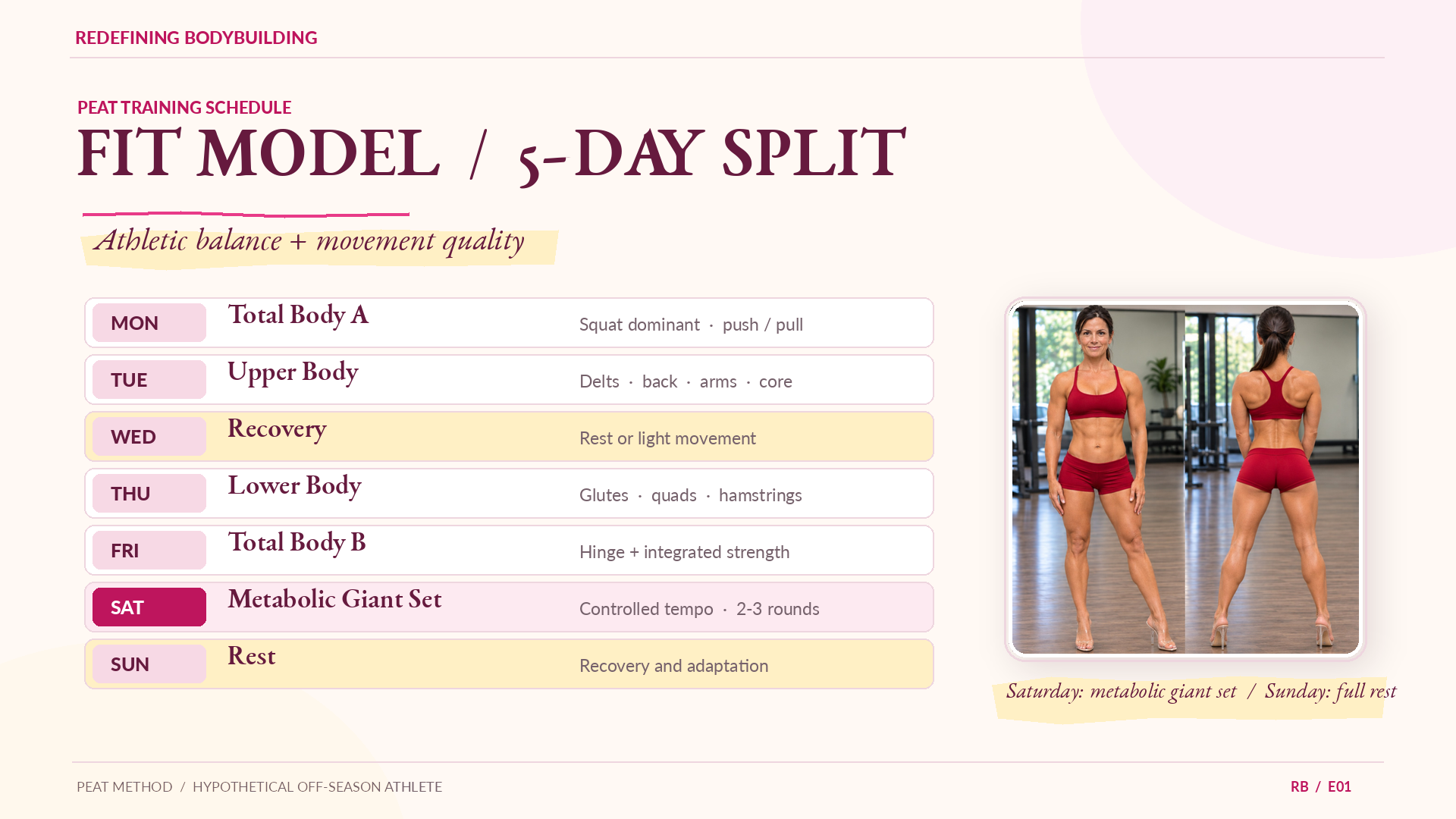
For my Fit Model athlete, I’m using total-body training as a substantial part of the program.
Monday begins with foundational movement patterns, potentially including goblet squats, seated cable rows, dumbbell chest presses, Romanian deadlifts, and rotational core work.
Tuesday gives us an opportunity to train the upper body more specifically through exercises such as lat pulldowns, shoulder presses, lateral raises, incline push-ups, and arm training.
Thursday becomes a dedicated lower-body session with exercises such as leg presses, reverse lunges, hamstring curls, hip thrusts, and calf raises.
Friday returns to integrated total-body training, although I’m careful not to make it another excessively demanding leg session immediately following Thursday.
Saturday introduces a metabolic resistance-training component.
For example, I might program the following giant set:
- Kettlebell deadlift: 15 repetitions
- Dumbbell squat-to-press: 12 repetitions
- Cable squat-to-row: 15 repetitions
- Alternating reverse lunge: 10 repetitions per leg
- High-to-low cable woodchop: 12 repetitions per side
Depending on the athlete’s conditioning and training phase, she might complete approximately two or three carefully controlled rounds, with the volume adjusted as needed.
The goal isn’t to perform the circuit as quickly as possible. I want meaningful resistance, controlled execution, and quality movement.
Fit Model’s Eight-Week Builder
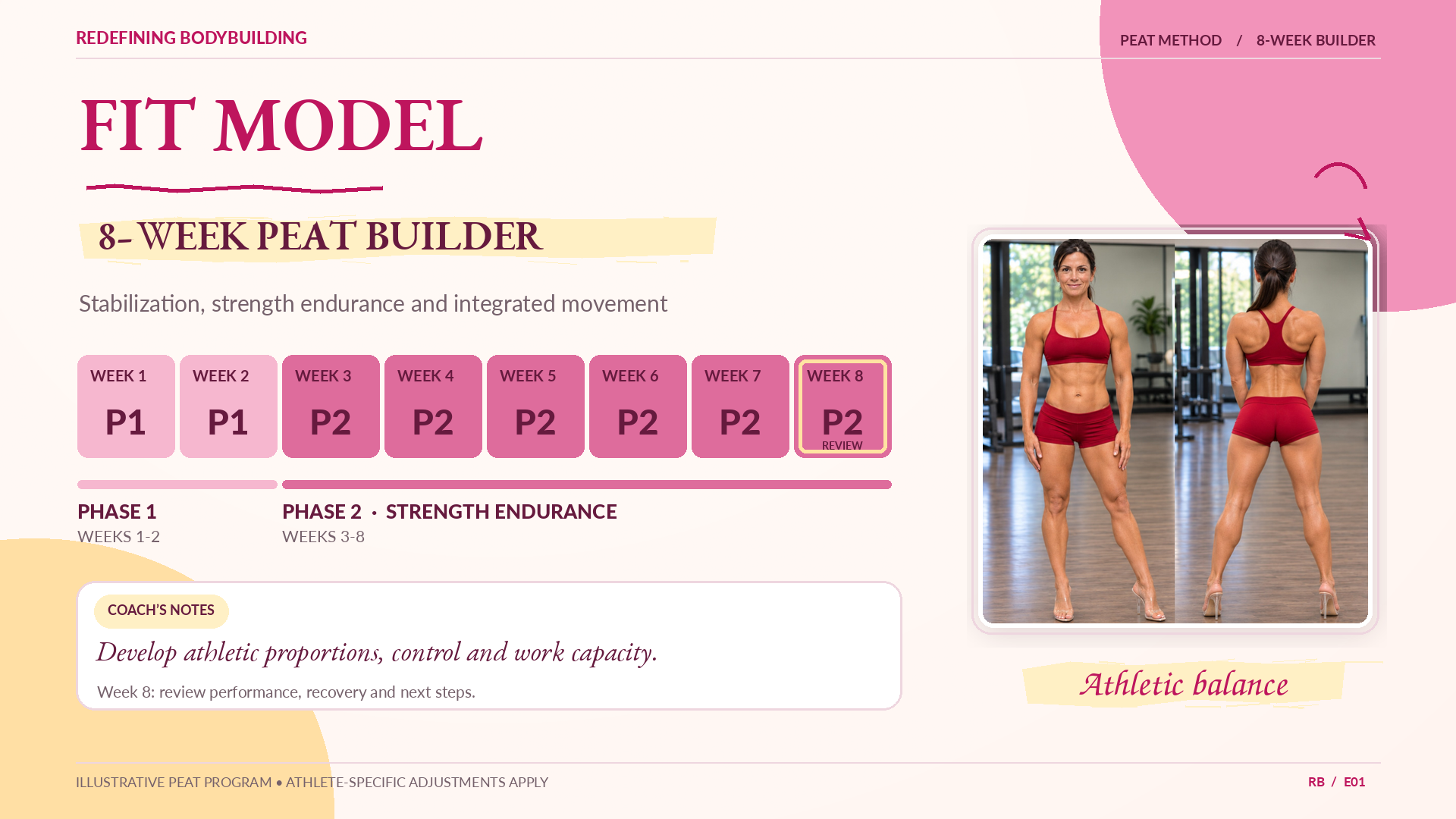
For this sample program, I would use:
- Weeks 1-2: Phase 1, emphasizing stabilization, muscular endurance, and movement quality.
- Weeks 3-7: Phase 2, with progressively challenging strength-endurance work.
- Week 8: Reassessment, fatigue management, and preparation for the next training block.
The result we’re pursuing is not maximum hypertrophy. It’s an athletic, proportionate physique developed through purposeful training.
Bikini: Directing More Training Toward Shape
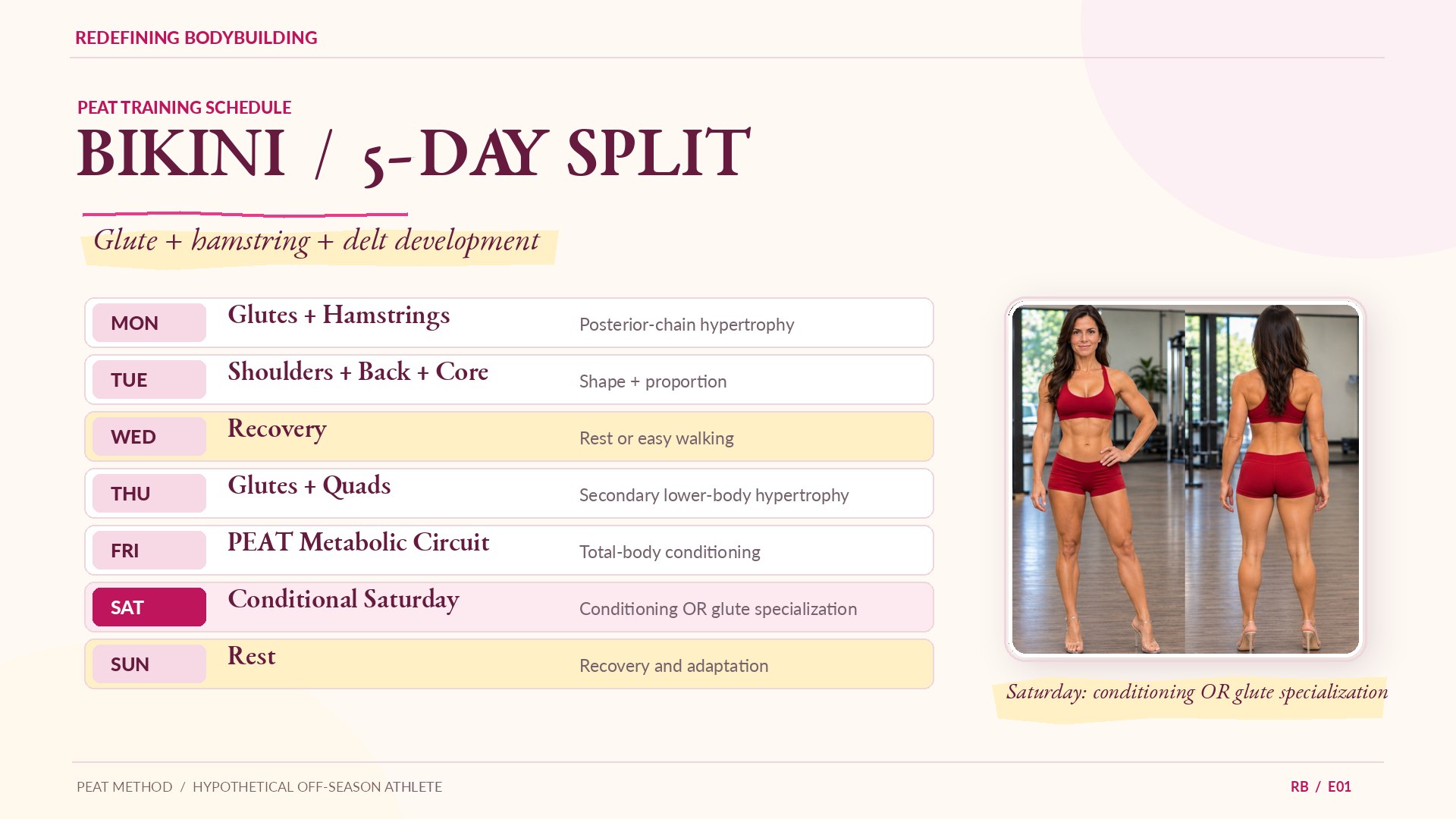
Now suppose that same woman decides she wants to compete in Bikini.
I’m keeping many of the same training principles, but I’m changing where I allocate her training resources.
Monday is dedicated to glutes and hamstrings.
Exercises might include barbell hip thrusts, Romanian deadlifts, seated hamstring curls, glute-biased back extensions, and cable hip abductions.
Tuesday emphasizes shoulders, back, and core, using movements such as lat pulldowns, lateral raises, seated cable rows, incline dumbbell presses, rear-delt exercises, and rotational core training.
Thursday becomes our second substantial lower-body day, this time emphasizing glutes and quadriceps.
I might program leg presses, Bulgarian split squats, cable kickbacks, hip abductions, and calf raises.
Friday provides a metabolic conditioning stimulus without unnecessarily interfering with the week’s more important hypertrophy sessions.
Why Saturday Is Conditional
Suppose my athlete has excellent shoulder development, but her glutes are lagging.
If she’s progressing well and recovering effectively, I might add a carefully controlled glute-specialization session on Saturday.
But what if her glutes are already appropriately developed?
Why would I automatically prescribe another glute workout?
I wouldn’t.
Saturday could instead involve low-impact conditioning, core work, mobility, or recovery.
That’s what individualized programming looks like.
Bikini’s Eight-Week Builder
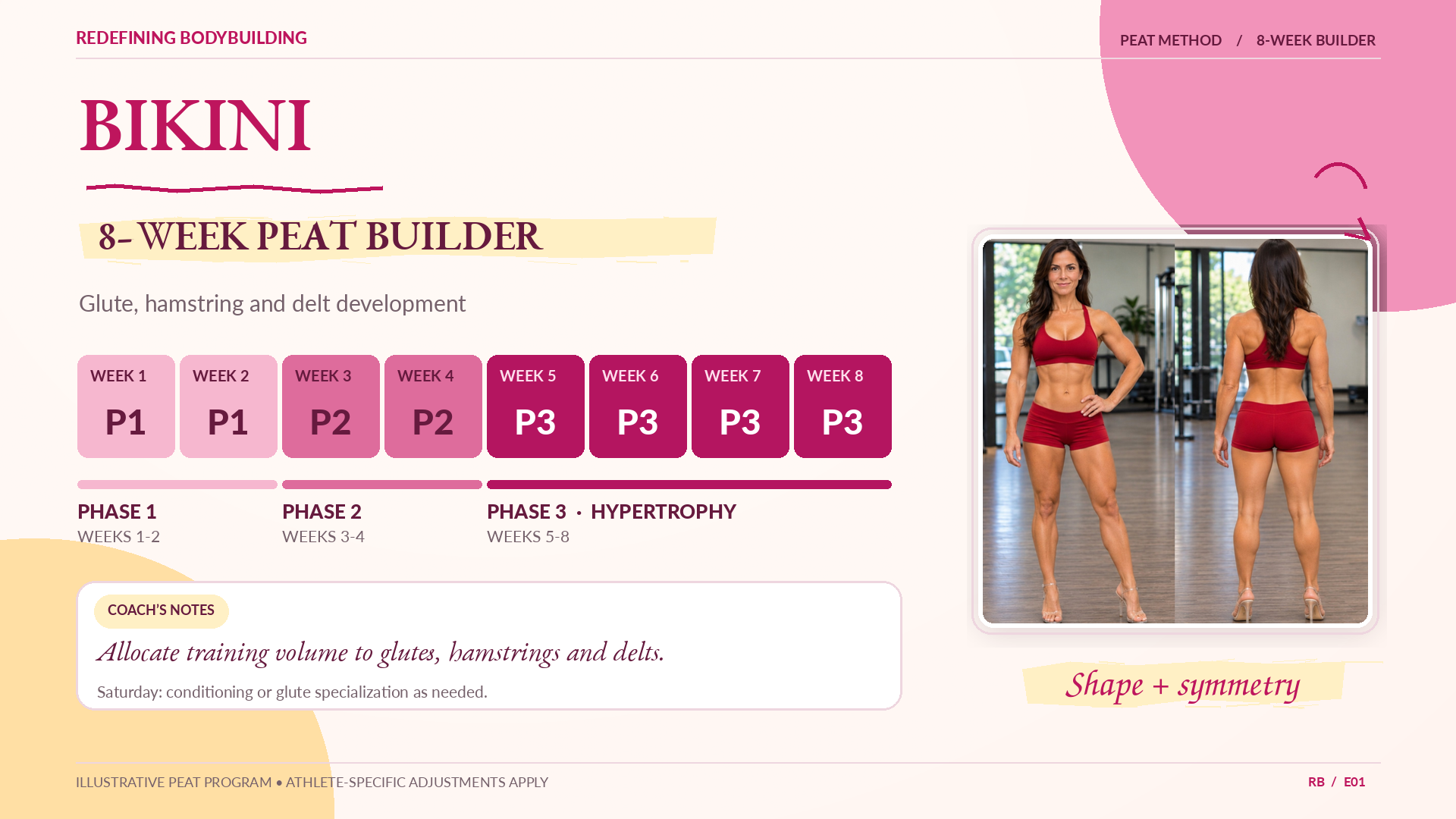
My hypothetical Bikini program might progress as follows:
- Weeks 1-2: Stabilization and muscular endurance.
- Weeks 3-4: Strength endurance.
- Weeks 5-8: Greater emphasis on hypertrophy.
The additional time spent emphasizing muscular development reflects the physique we’re attempting to build.
For a private client, I might extend the hypertrophy emphasis over a considerably longer off-season, depending on her starting point.
Wellness: More Lower-Body Hypertrophy, Not More Work for Its Own Sake
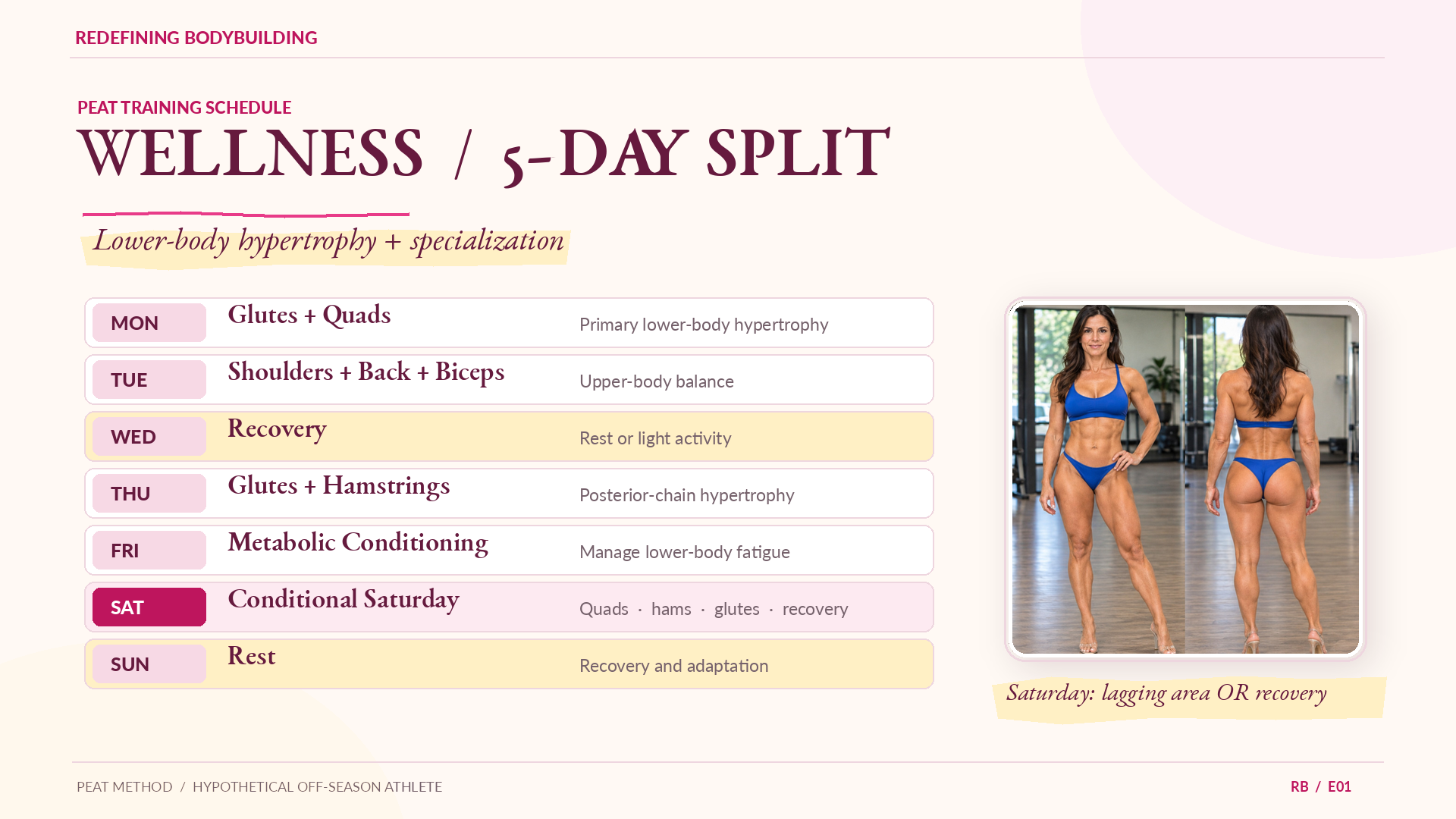
With Wellness, we’re deliberately prioritizing greater muscular development in the lower body.
Monday emphasizes glutes and quadriceps.
I might program hack squats, barbell hip thrusts, leg presses, leg extensions, cable hip abductions, and calf raises.
Tuesday is still an important upper-body workout, incorporating back, shoulder, and arm development.
I’m not neglecting the upper body. I’m simply distributing our training resources according to the Wellness physique objective.
Thursday shifts toward glutes and hamstrings.
Exercises might include Romanian deadlifts, glute-biased leg presses, seated hamstring curls, reverse lunges, cable kickbacks, and seated calf raises.
Friday includes total-body conditioning, but I want to be careful about how much additional lower-body fatigue we create.
The Most Important Saturday Decision
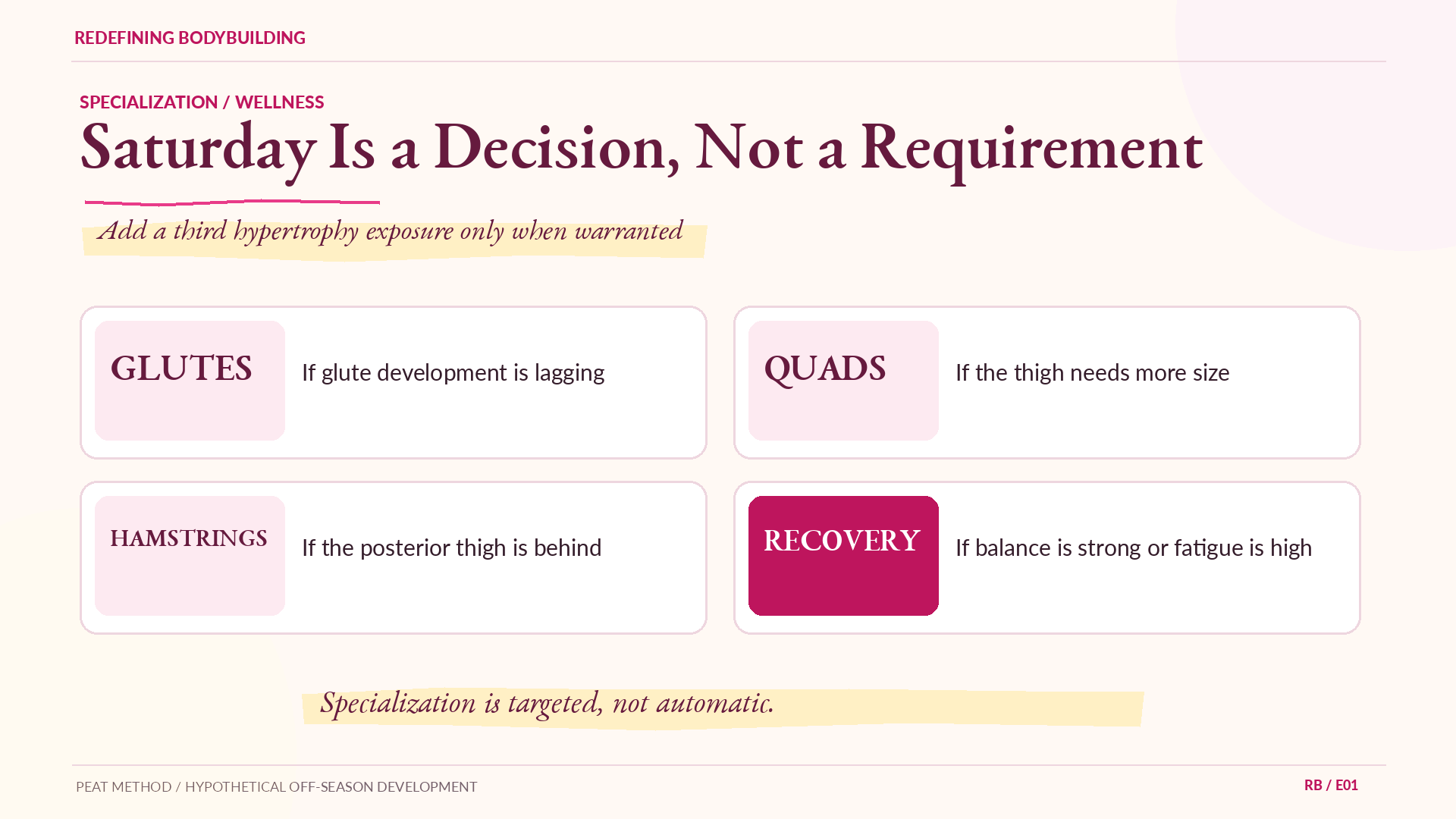
Saturday is where I might make the most individualized adjustment.
If the athlete’s quadriceps are underdeveloped relative to her glutes and hamstrings, I may introduce some quad-specialization work.
If her hamstrings need more development, I might use a different selection of exercises.
If her glutes need additional attention, that becomes the potential emphasis.
But suppose her lower body is already developing beautifully and the proportions are appropriate.
Then the smartest decision may be to avoid adding more hypertrophy work.
And if she’s struggling to recover, adding another workout may actively work against the result we’re trying to achieve.
More training is only useful when the athlete can recover from it and adapt to it.
That’s a principle I wish more women understood before assuming the solution to every physique concern is another exercise, another set, or another training day.
Wellness’s Eight-Week Builder
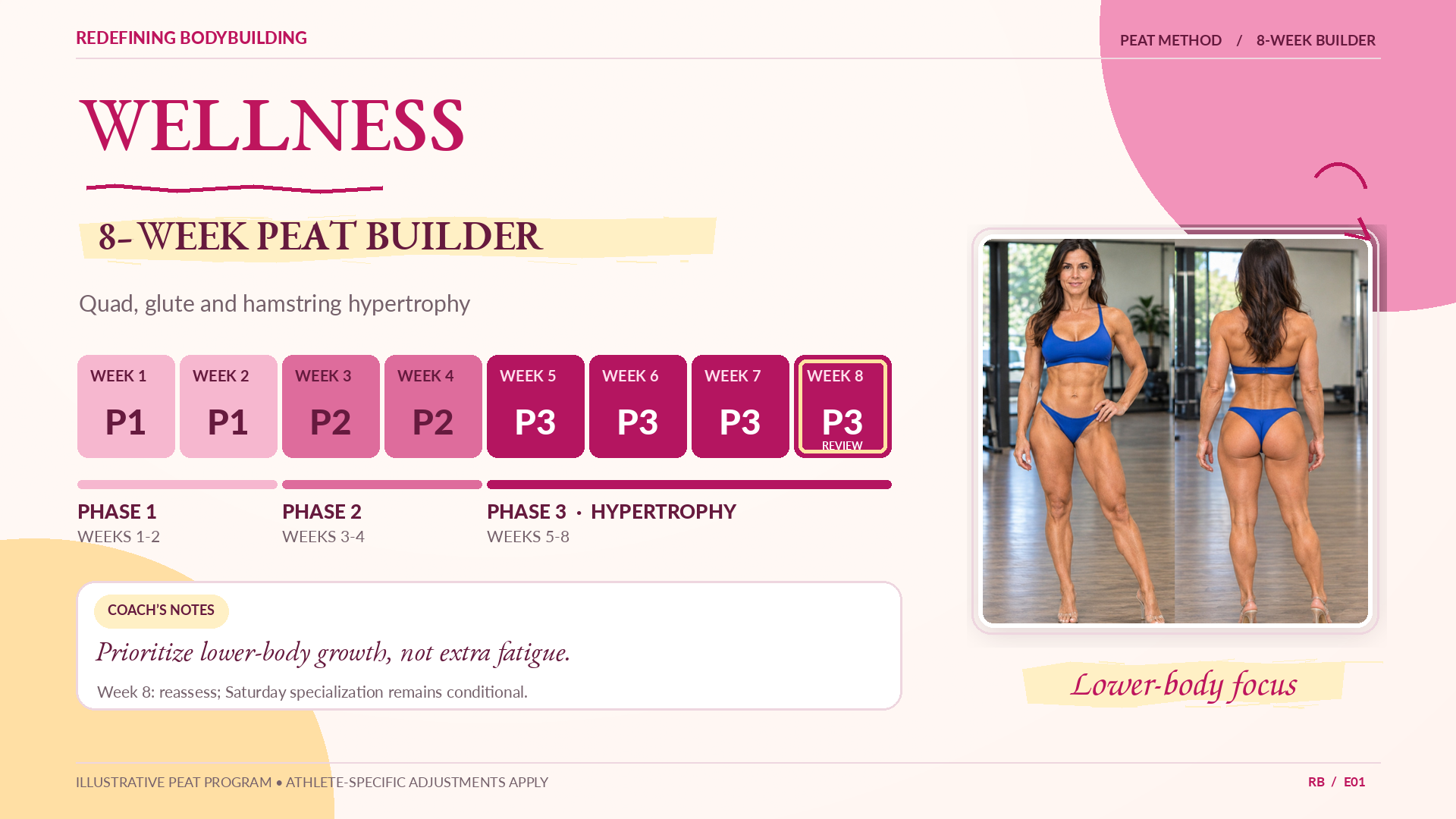
For the sample Wellness program:
- Weeks 1-2: Stabilization and muscular endurance.
- Weeks 3-4: Strength endurance.
- Weeks 5-7: Hypertrophy, with greater lower-body emphasis.
- Week 8: Continued assessment of hypertrophy progress, recovery, and the next training block.
In actual individualized coaching, that lower-body development process may extend across 16-20 weeks or longer before contest prep even enters the conversation.
The objective is to develop the necessary physique, not rush the athlete to satisfy an arbitrary deadline.
Why These Are Not Eight-Week Contest Prep Programs
I want to make a critical distinction.
These eight-week examples are off-season physique-development frameworks.
They are not promises that someone can become competition-ready in eight weeks.
The time required to build a competitive physique depends on training history, existing muscular development, recovery, division requirements, and the individual’s circumstances.
For some women, the priority may be developing an entire foundation of consistent resistance training.
For others, it may be a period of targeted hypertrophy.
And for an athlete who has already developed the physique she needs, an appropriate contest-prep phase may be the next step.
Those are three different situations requiring different decisions.
What Changes When Contest Prep Begins?
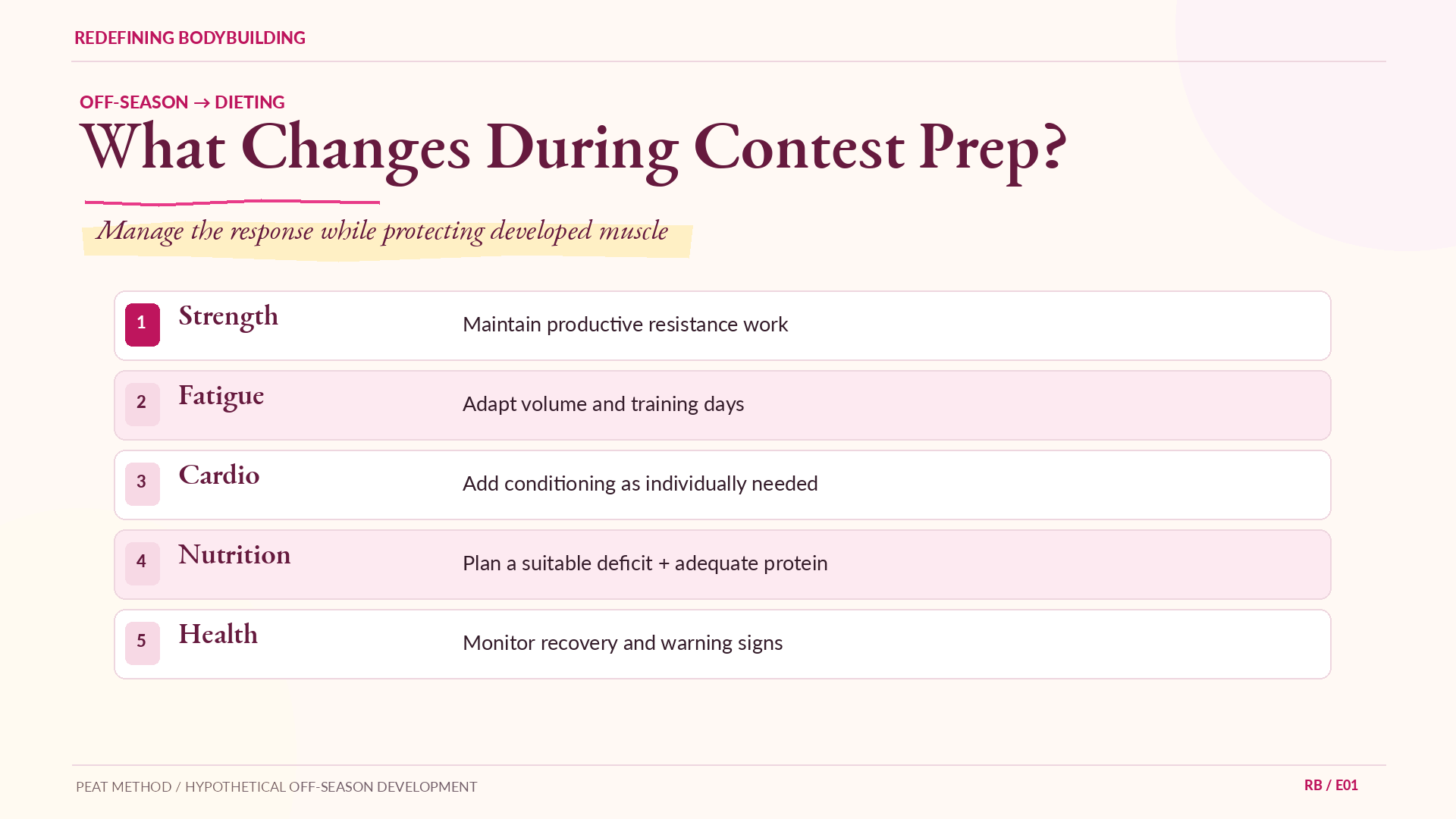
Once we transition into contest prep, the objective changes.
We’re now working toward the conditioning required for a particular competition while attempting to preserve as much hard-earned muscle and performance as possible.
That doesn’t mean abandoning challenging resistance training and replacing it with endless repetitions using extremely light weights.
It means continuing to provide an appropriate training stimulus while managing nutrition, recovery, fatigue, and conditioning demands.
As the athlete becomes leaner, her ability to recover may change.
We may need to adjust volume, exercise selection, training frequency, or cardiovascular work.
And for women over 40, I want those decisions made with particular attention to sleep, stress, recovery, and overall health.
Competitive bodybuilding can impose significant physiological demands, particularly when women pursue very low body-fat levels. Stage condition should not be confused with a sustainable year-round health target.
A thoughtful contest prep respects that distinction.
How Do You Know Which Division Is Right for You?
This is where I’d encourage you to look beyond the photographs on social media.
You might love the appearance of a Wellness competitor, but that doesn’t automatically mean Wellness is the best competitive direction for your current physique.
Perhaps you already have excellent lower-body development.
Perhaps your upper body is more naturally developed.
Perhaps you have limited training experience and need a longer foundation-building phase before choosing any division.
Your preferences matter, but so do your current development, training history, recovery capacity, and the standards of the federation in which you intend to compete.
The decision shouldn’t be based entirely on which division has the most appealing photos.
And it certainly shouldn’t be made by someone who hasn’t taken the time to understand your starting point.
Start With Your Contest Prep Readiness Assessment
If you’re considering your first competition, begin by exploring your current training foundation and potential competitive direction.
Take the RoxStar Contest Prep Readiness Assessment
This free tool helps organize your goals, training experience, and planning considerations. It provides a starting point for discussion rather than a definitive determination of competitive readiness.
You can also read my Ultimate Beginner’s Guide to Wellness Physique Competitions or my Complete Guide to Your First Bodybuilding Competition After 40.
Train With Direction, Not Guesswork
Not every woman needs private contest prep coaching.
Some women simply need a professionally structured training program that tells them what to do, how to progress, and how to build consistency.
Others need individualized guidance because they’re preparing for competition, managing specific physique-development goals, or finding that their existing training isn’t producing the results they expect.
That’s why I offer different ways to work with me.
If you want structured, done-for-you training programs with workout tracking and nutrition resources, explore the Redefining Bodybuilding All-Access Membership.
If you’re looking for personalized training strategy or considering serious contest prep, begin with my complimentary Clarity Call readiness check to explore whether private coaching is an appropriate next step.
The Real Difference Between Following a Workout and Developing a Physique
After decades of coaching women, one of the most valuable lessons I’ve learned is that you don’t need to change something simply because you’ve reached the end of a calendar.
You also don’t need to add more work because a program looks more impressive when it’s complicated.
You need to understand what you’re trying to accomplish and how your body is responding.
The same athlete can pursue Fit Model, Bikini, or Wellness, but the way we allocate her training needs to reflect the specific objective.
And even within the same division, two women may need different exercise selections, training volumes, and developmental timelines.
The division determines the direction. The individual determines the programming.
That’s the difference between following a workout and developing a physique.
And that’s what I want women to understand about bodybuilding.
Strength, muscular development, and the ability to train well are built through deliberate decisions over time, not through constantly doing more.
So let me ask you: Which division interests you the most, Fit Model, Bikini, or Wellness? And which areas of your physique would you most want to develop?
I’d love to hear your thoughts in the comments.